
What an Arabic crypto wallet should translate
Waletifi translates every screen, button and warning into Arabic and mirrors the layout, including Arabic plural forms such as one, two and several. Amounts, dates and the security warnings read naturally from right to left.
Arabic is the default for Iraq, Oman, Kuwait, Qatar, Bahrain, Saudi Arabia, Syria, Jordan and Lebanon, and the UAE offers it next to English.
Hijri dates and your choice of digits
The calendar can be Gregorian or Hijri (Umm al-Qura). Digits can be Latin or Arabic-Indic: the default is Arabic-Indic in Iraq and Syria and Latin in the Gulf, where bank apps show Latin digits.
If you switch to Arabic from another default language, the app starts with Arabic-Indic digits and Hijri dates. You can change both under Me, then Region settings.
Currencies with three decimals
The Omani rial, Kuwaiti dinar, Bahraini dinar and Jordanian dinar are shown with three decimals, the UAE dirham and the Saudi and Qatari riyals with two, and the Iraqi dinar with none. Amounts are exact decimals, never floating-point numbers.
In countries where no reliable local rate exists, the app shows prices in US dollars and says so.
P2P with local bank transfers, where available
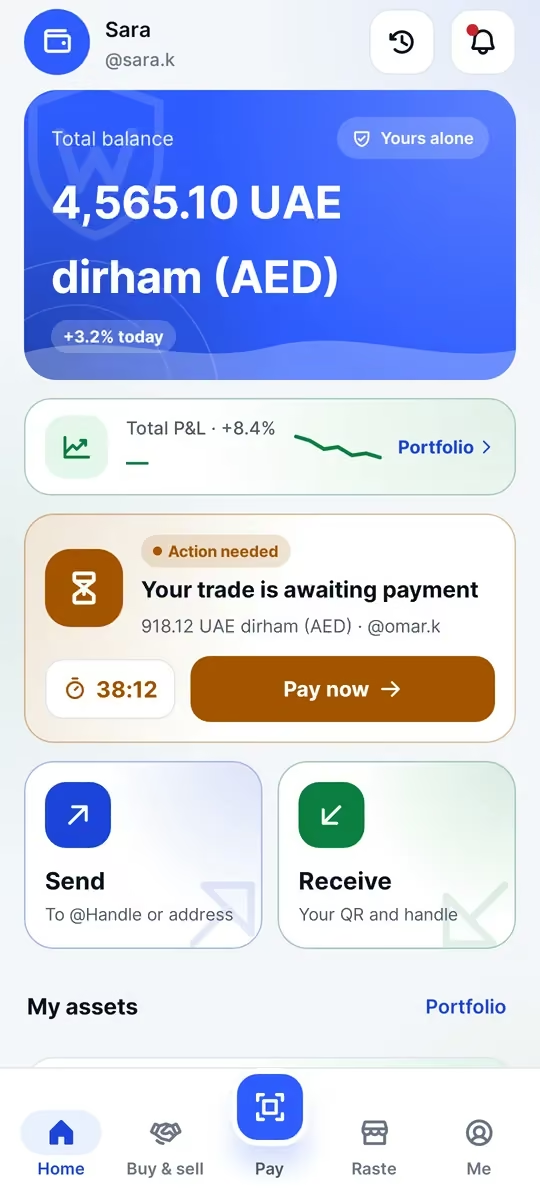
Where P2P is available, you buy or sell USDT with other users through an on-chain escrow, using IBAN bank transfers in the UAE, Saudi Arabia, Qatar, Bahrain, Kuwait and Iraq, plus instant rails and mobile wallets in some countries.
Payment deadlines follow each country’s banking week, for example Friday and Saturday off in Saudi Arabia and Saturday and Sunday in the UAE. P2P needs an identity check, but the wallet itself needs no phone number or email.